

Introduction
In single-cell discovery, the pressure to find the right cell faster has never been greater. Whether researchers are working in antibody discovery, cell line development, or other complex therapeutic workflows, the biological questions being asked are becoming more nuanced and the tools used to answer them need to keep pace.
For Richard Hammond, Chief Technical Officer at Fluidic Sciences, this is why single-cell discovery needs more than a “one assay fits all” mindset.
In this first post, Richard’s perspective is focussed on the principle: why relying on one assay alone can limit discovery, particularly when rare cells and complex therapeutic questions are involved. In Part 2, Richard will look in more detail at some of the assays themselves, including how different approaches can be used to detect and characterize rare antigen-specific antibody-secreting cells.
Thoughts from Richard Hammond
Discovery workflows have often relied on a single assay format. These assays have delivered tremendous value but can introduce bias. There is the inevitable trade-off between sensitivity and specificity. Some focus on molecule presence, others on molecule interactions. None can capture the full picture, and you run the risk of only seeing what you look for – like nails and hammers.
As therapeutic approaches become more complex, this limitation can start to become more visible. Researchers want to know more about their systems in their context, or search based on multiple signals, and one assay is not enough.

If you possess a hammer, everything looks like a nail
This is especially true where you are searching for rare cells such as in antibody discovery workflows. You can’t afford to just have one tool in your toolbox and miss the best cell because you didn’t look in the right way.
‘There is no single way to see biology – and no single assay to capture it in full’
Understanding requires context and no single assay can fully describe the complexity of a biological system. But we can look at a system in multiple ways and build the picture. We need to combine perspectives by looking at the relevant things and joining the data together.
Confidence in your decisions requires more than a single readout; and this requires a set of ready-to-use tools that provide the data you need.
How Picodroplet-based Microfluidics Can Help
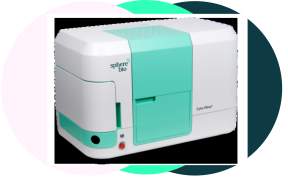
That need for assay flexibility is part of our approach and our R&D team work hard to demonstrate proof of principle for researchers who are using or would like to use our Cyto-Mine® platforms to streamline their workflows. They are designed to bring together screening, isolation, imaging, secretion assessment, monoclonality checking, and dispensing into microwell plates in a simplified, hands-off workflow.
By using picodroplet technology, each cell can be compartmentalized in a tiny, protective assay environment, helping researchers assess antibody secretion at the single-cell level while maintaining cell viability through incubation and sorting. This enables teams to screen large populations of B cells or hybridomas rapidly and make more informed decisions earlier in discovery.
Importantly, this is not about replacing one assay with another single answer, but about giving researchers practical routes to choose the most appropriate readout for their biological question.
For example, we support multiple assay routes for detecting rare, antigen-specific, antibody-secreting cells. These include optimized FRET-based and bead-based approaches for use with Cyto-Mine® platforms, helping researchers select the assay strategy that best fits their biology.
Protocols to Put Principles into Practice
Our latest protocols provide practical starting points for detecting rare, antigen-specific antibody-secreting cells. Take a look at the different assay approaches including antigen-specific FRET and streptavidin bead-based assays for Cyto-Mine® platforms.
Example FRET-Based Assay Workflow

Example Streptavidin Bead-Based Assay Workflow

Authors: Richard Hammond, Chief Technical Officer, Fluidic Sciences, and Claire Cox, Director of Global Marketing, Fluidic Sciences.
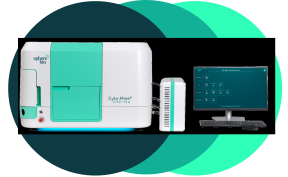
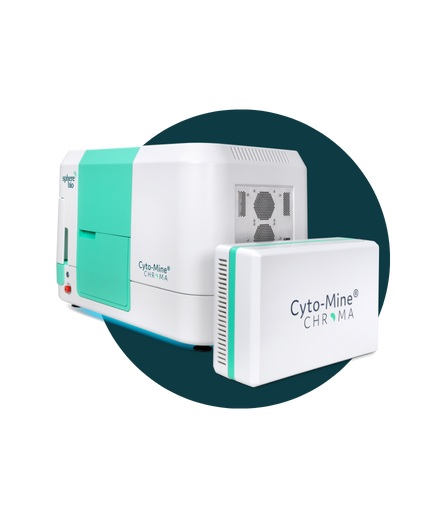
The Next Generation: Cyto-Mine® Chroma
Automate. Accelerate. Analyze millions of cells in a single day.
Think Cyto-Mine®, but supercharged, enabling multiplexing and greater assay flexibility to fit your needs. It means that you can examine vastly greater numbers of cells — and isolate the most valuable ones— with unparalleled precision.
Stay ahead with Fluidic Sciences
Join our community of forward-thinking scientists. Stay informed with the latest breakthroughs, product launches, and industry research. Subscribe to our newsletter and be the first to know about innovations that can transform your lab.