



Stable, high‑performing cell lines are essential for biologics production, antibody discovery, cell therapy research, and beyond. Yet, traditional cell line development workflows often introduce bottlenecks – manual handling, inconsistent clone performance, and limited screening throughput. By combining optimized engineering strategies with automated single‑cell analysis platforms, researchers can streamline development and reliably identify stable cell lines that drive scalable innovation.
In this post we’ll walk through key stages of cell line development, unpack common challenges, and highlight how automated single‑cell technologies can streamline the journey toward stable cell lines that support scalable research and development.
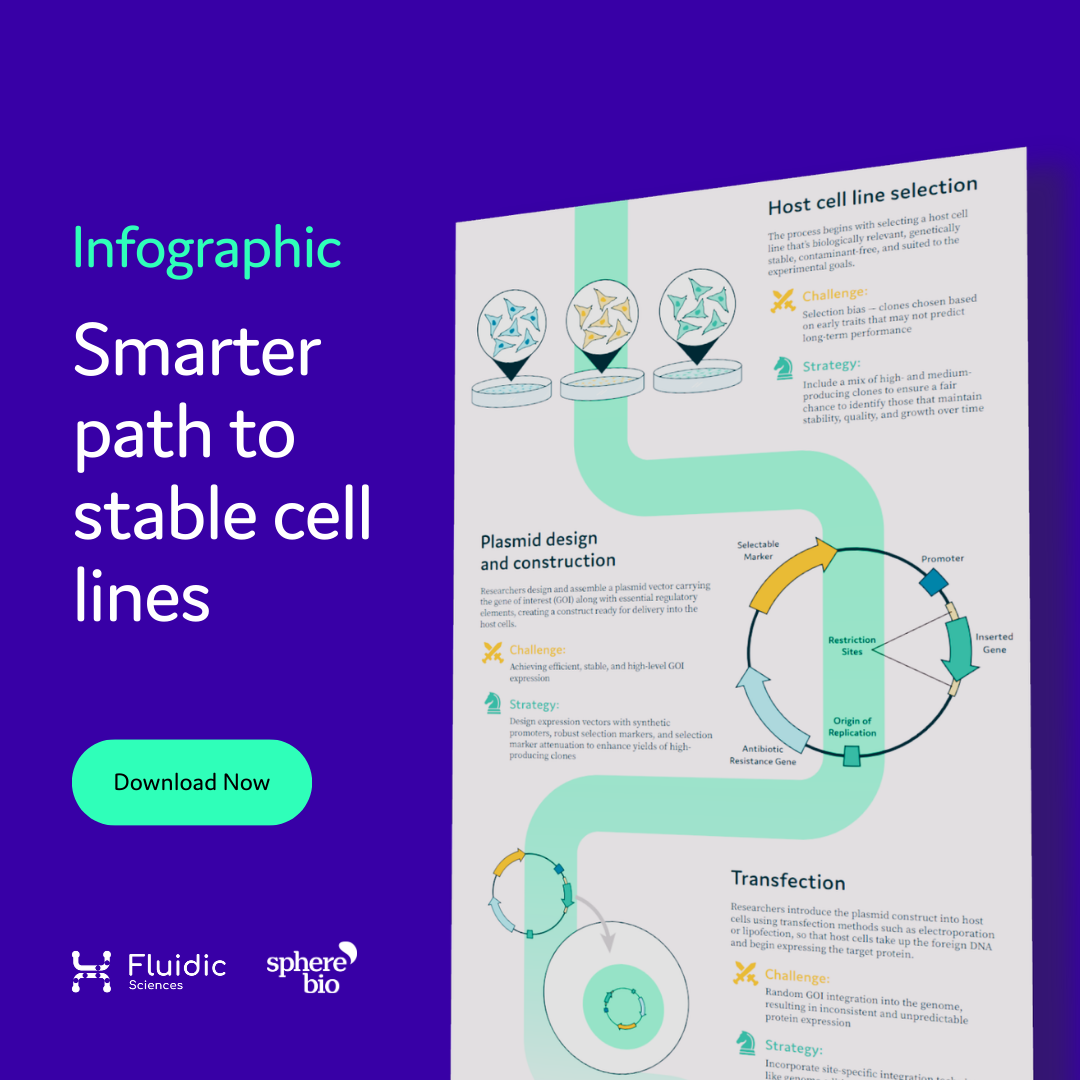
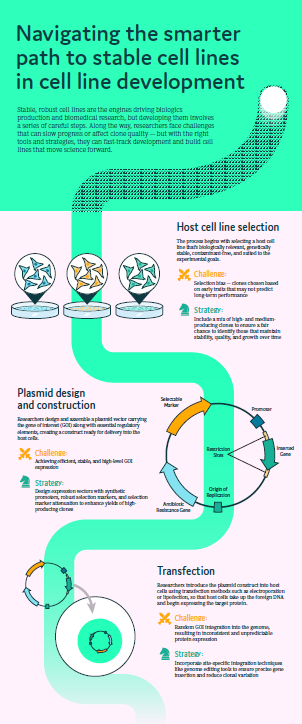
We’ve also created a handy infographic with all the key highlights for you to download.
1) Host Cell Line Selection: The Foundation of Successful Cell Line Development
The Challenge: Selection Bias Sneaking In
A Smarter Strategy
2. Plasmid Design & Construction: Engineering the Blueprint for Success
The Challenge: Ensuring High‑Level, Stable Expression
A Smarter Strategy
3. Transfection: Introducing the Construct with Precision
The Challenge: Random Integration Leading to Variability
A Smarter Strategy
4. Cell Cloning & Selection: Discovering the Clone That Can Carry the Program
The Challenge: Manual Bottlenecks and Limited Throughput
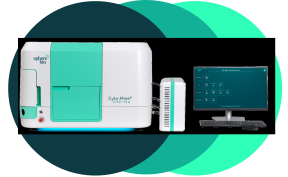
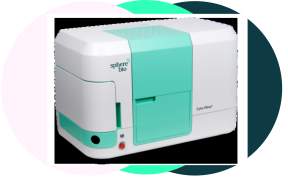
A Smarter Strategy: Automation with Cyto‑Mine®
Cyto‑Mine® brings clarity and speed to this process. Powered by picodroplet microfluidics, this platform encapsulates single cells in tiny droplets – each one a miniature bioreactor – and then completes what normally requires several instruments in just one automated workflow. It can:
- Encapsulate up to 400,000 single cells
- Screen each for antibody secretion
- Sort top performers
- Provide image‑based monoclonality assurance
- Dispense selected cells into 96‑ or 384‑well plates
5. Clone Expansion: Scaling Promising Candidates with Confidence
The Challenge: Performance Drift During Scale‑Up
A Smarter Strategy
A stepwise expansion process, supported by early analytical tools like Cyto‑Mine® and Cyto‑Mine® Chroma, helps researchers stay ahead of potential issues. Real‑time insight ensures clone stability, productivity, and quality remain consistent as they grow.
Pulling It All Together: A More Scalable, Reproducible Future
Each step in the development of a stable cell line requires care, precision, and the right technologies. When workflows are optimized – from host selection to final expansion – researchers can move more confidently and efficiently from early discovery into therapeutic development.
Automated platforms like Cyto‑Mine® empower teams to:
- Reduce variability and manual error
- Increase screening throughput dramatically
- Achieve image‑verified monoclonality
- Make faster, data‑driven decisions
- Support scalable, reproducible biologics development programs
Ready to Transform Your Cell Line Development Workflow?
Learn more about how to build better cell lines – faster, and with confidence – here.
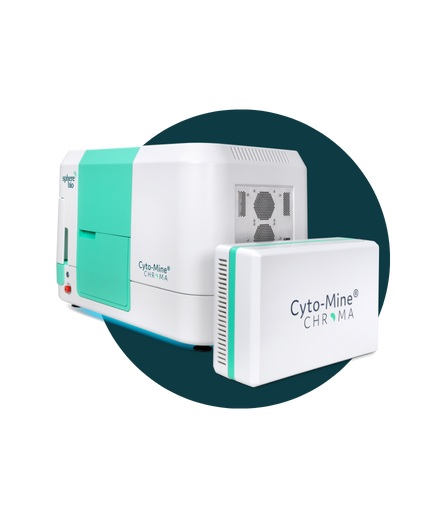
The Next Generation: Cyto-Mine® Chroma
Automate. Accelerate. Analyze millions of cells in a single day.
Think Cyto-Mine®, but supercharged, enabling multiplexing and greater assay flexibility to fit your needs. It means that you can examine vastly greater numbers of cells — and isolate the most valuable ones— with unparalleled precision.

Stay ahead with Fluidic Sciences
Join our community of forward-thinking scientists. Stay informed with the latest breakthroughs, product launches, and industry research. Subscribe to our newsletter and be the first to know about innovations that can transform your lab.